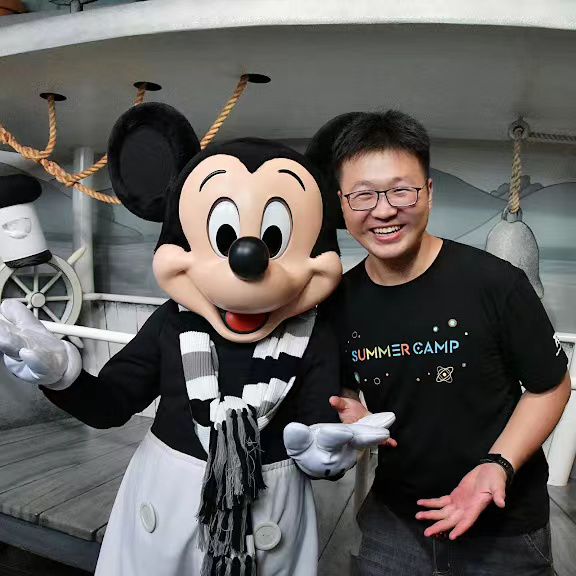
I am Teng Xue, a final-year PhD student at Ecole Polytechnique Federale de Lausanne (EPFL) and a research assistant at Robot Learning and Interaction Group (RLI), Idiap Research Institute, supervised by Dr. Sylvain Calinon. Before joining Idiap/EPFL, I was fortunate to work as a visiting student at ETH RSL and Stanford Artificial Intelligence Lab (SAIL). I did my internships in DJI (2016), Flexiv Robotics (2021) and Meta Reality Labs (2025-2026). I am on the job market this year! Feel free to reach out.
My research focuses on inference-efficient compositional intelligence for robot generalization. How can robots reuse what they have learned to solve new tasks, while keeping the computation required to decide and act manageable? Compositionality offers a way to build complex behaviors from reusable skills, models, and constraints, but it also introduces a computational challenge: the number of possible combinations grows rapidly with task horizon and environmental complexity. In contact-rich manipulation, this challenge is compounded by uncertain dynamics and the need to react to feedback during execution. To address these challenges, I combine structured representations of value functions and probability distributions with task decomposition, enabling robots to reuse learned knowledge while reducing the computational cost of planning and adaptation. My work connects three research directions:
Composing skills into long-horizon plans. How can independently learned skills be sequenced while accounting for their downstream consequences? In Logic-Skill Programming (RSS 2024), we combine symbolic search with optimization over skill value functions to jointly determine skill sequences and intermediate geometric goals. Our work on learning problem decomposition (RA-L 2025) learns subgoal structure and reduces the objects considered during replanning, making task decomposition a means of reducing computational effort as well as organizing behavior.
Making composition and search computationally tractable. How should knowledge be represented so that combining constraints or exploring alternatives remains efficient? Our motion planning with products of experts (IJRR 2025) combines distributions encoding optimality and feasibility to concentrate sampling on admissible motions. In Tensor Train Tree Search, we exploit correlations across search branches through tensor factorization to reduce computation and storage. These works use structured representations to make the underlying planning operations more efficient.
Adapting reusable behaviors through feedback. How can a learned behavior respond to new physical conditions and observations at execution time? Implicit Motor Adaptation (IJRR 2025) retrieves adapted policies from a tensor representation using distributions over uncertain physical parameters, without policy retraining. Tube Diffusion Policy combines generative action prediction with visual-tactile feedback corrections, enabling reactive feedback control at over 100 Hz with fewer denoising steps. These approaches connect reusable representations to the demands of online control.
My long-term goal is to build robots whose capabilities grow through the composition of accumulated knowledge, with representations that support both flexible generalization and efficient decisions under physical uncertainty.
Recent News
New (2026/01) Our workshop Workshop on Manipulation Robustness: Towards Human-Level Robustness under Real-World Challenges is accepted to ICRA 2026.
New (2025/10) Our paper Sampling-Based Constrained Motion Planning with Product of Experts is accepted to International Journal of Robotics Research (IJRR)!
New (2025/10) Our paper Learning Problem Decomposition for Efficient Sequential Multi-object Manipulation Planning is accepted to IEEE Robotics and Automation Letters (RA-L)!
New (2025/04) Our paper Robust Contact-rich Manipulation through Implicit Motor Adaptation is accepted to International Journal of Robotics Research (IJRR)!
(2024/09) Our paper Robust Manipulation Primitive Learning via Domain Contraction is accepted to Conference on Robot Learning (CoRL), 2024!
(2024/08) Our paper Design and Control of Roller Grasper V3 for In-Hand Manipulation is accepted to IEEE Transactions on Robotics (T-RO)!
(2024/06) Our paper Logic-Geometric Planning and Control Using Graph of Tensor Networks is accepted to RSS24 workshop: Frontiers of optimization for robotics !
(2024/06) Our paper Logic Learning from Demonstrations for Multi-step Manipulation Tasks in Dynamic Environments is accepted to RA-L!
(2024/05) Our paper Logic-Skill Programming: An Optimization-based Approach to Sequential Skill Planning is accepted to Robotics: Science and Systems (RSS), 2024!
(2024/02) I was fortunate to visit TU Berlin and give a talk at the Learning and Intelligent Systems research lab, led by Prof. Marc Toussaint .
(2024/01) Our paper D-LGP: Dynamic Logic-Geometric Program for Combined Task and Motion Planning is accepted to ICRA 2024!
(2024/01) Our paper Generalized Policy Iteration using Tensor Approximation for Hybrid Control is accepted to ICLR 2024 as spotlight (Top 5%)!
(2023/01) Our paper Demonstration-guided Optimal Control for Long-term Non-prehensile Planar Manipulation is accepted to ICRA 2023!
(2022/01) One paper about Robot Grasping in Dense Clutter is accepted to Robotics and Autonomous Systems!
(2020/05) One paper about Multimodel Fusion in pHRI is accepted to IEEE sensors journal!
(2020/02) One paper about Sequential Robot Manipulation is accepted to IEEE Access!
(2019/05) One paper about Tactile Grasping is accepted to ViTac workshop in ICRA 2019!
(2018/05) Our team, Kaibot, won the First Place in Tidy Up My Room Challenge in ICRA 2018!
(2017/02) We won the Outstanding Winner (1/8085) of MCM/ICM competition held by American Consortium for Mathematics and Its Application (COMAP). A nice collaboration with Yasheng and Taihang!